Invoicing course
Learn a reliable invoicing workflow for UK businesses, from customer setup to clean bank reconciliation.
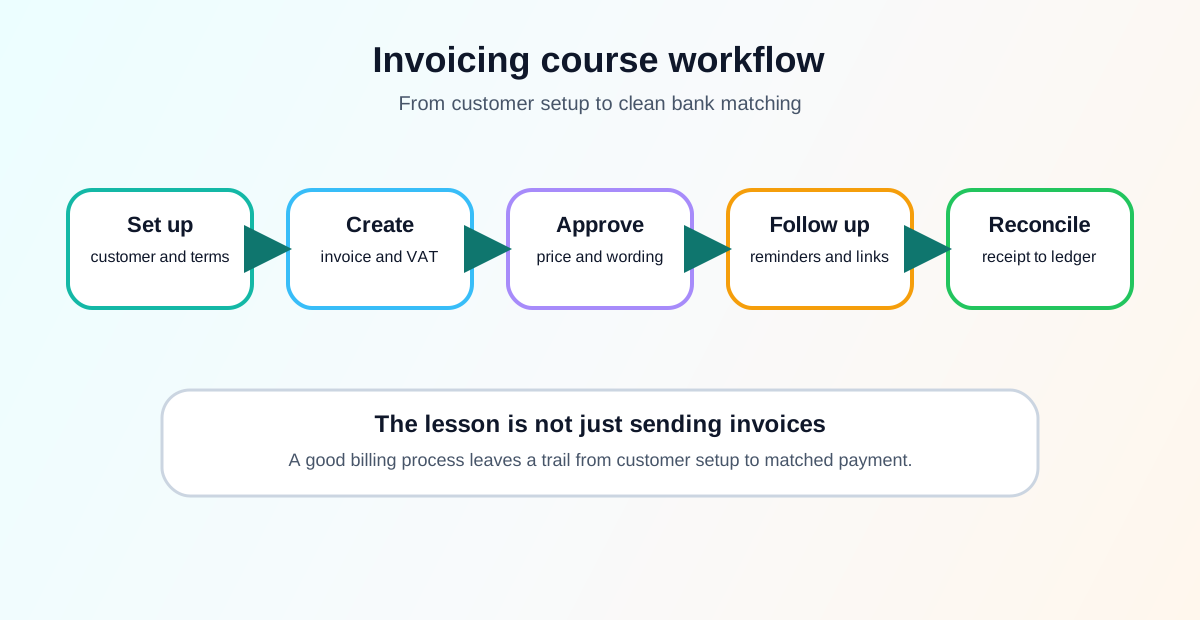
This invoicing course is a practical learning path for UK businesses that want invoices to go out faster, be approved properly and reconcile cleanly when customers pay. It is designed for founders, finance assistants, bookkeepers and operations teams who need a repeatable billing routine rather than a pile of one-off invoice habits.
Use it alongside the detailed guide on how to write an invoice when you need the exact fields, VAT details and numbering rules.
Who this course is for
This course is useful if:
- Invoices are delayed because customer, pricing or VAT details need checking.
- Different people issue invoices in different formats.
- Payments arrive with poor references and take too long to allocate.
- Credit notes, disputes or overdue balances are handled informally.
- Month-end reporting is slowed down by open sales ledger questions.
Course path
| Module | What you learn | Output |
|---|---|---|
| 1. Customer and contract setup | What to confirm before the first invoice is raised | A cleaner customer record and billing note |
| 2. Invoice creation | Invoice fields, numbering, VAT treatment and payment references | A consistent invoice template |
| 3. Approval before issue | Who checks price, scope, VAT and customer details | A simple invoice approval workflow |
| 4. Sending and follow-up | Email wording, payment links and overdue reminders | A practical follow-up routine |
| 5. Allocation and reconciliation | Matching receipts, part payments and overpayments | Clear payment allocation rules |
Practical exercise
Take one recent customer invoice and trace it end to end:
- Check whether the customer details and billing address were complete before the invoice was raised.
- Confirm the invoice number, date, supply description, payment terms and VAT treatment.
- Identify who approved it and where that approval is recorded.
- Review the email or payment link used to send it.
- Match the eventual bank receipt to the invoice and note any allocation issue.
If you cannot follow the chain without searching email threads, the workflow is too fragile. A good invoicing process leaves a clear record inside the finance system.
Common mistakes to fix
The first mistake is treating invoicing as an admin task only. It is also a control over revenue, VAT and cash collection. The second mistake is leaving payment allocation until month end, when references are harder to interpret and customer balances are already stale.
Watch especially for:
- Invoice numbers created outside the main sequence.
- Draft invoices sent before price or VAT review.
- Customer payments posted to suspense instead of the sales ledger.
- Credit notes issued without a clear link to the original invoice.
- Recurring invoices that continue after the service has changed.
Use recurring invoice review and statement of account for customers when the issue is repeated billing or messy customer balances.
Outcome
By the end of the course, you should have a repeatable invoicing workflow that improves billing speed, reduces errors and supports cleaner month-end reporting. The practical sign that it works is simple: every issued invoice has a customer, approval, payment route and reconciliation trail that another person can understand.
For broader finance setup, continue with bank reconciliation for UK accounting and bookkeeping quality checks .