Closing profit and loss accounts at year end
Income and expense accounts do not carry forward like balance sheet accounts. This guide explains how year-end closing moves profit or loss into reserves.
Closing profit and loss accounts at year end is one of those accounting steps that feels technical until it goes wrong. Then it suddenly explains why the trial balance, opening balances and retained earnings do not seem to line up.
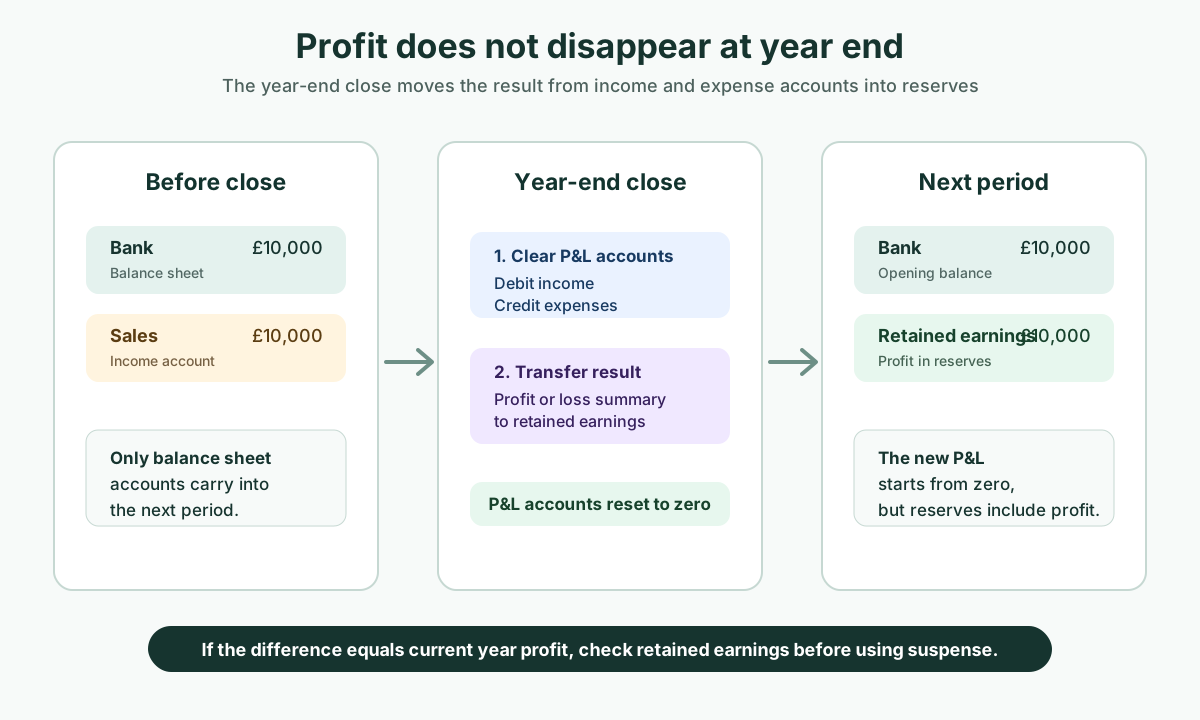
The short version is simple: income and expense accounts are temporary. They measure what happened during one accounting period. At year end, they are closed so the next period starts with a clean profit and loss account. The effect of the profit or loss does not disappear. It moves into the balance sheet, normally through retained earnings or the profit and loss account reserve.
This matters when preparing annual accounts and notes , filing a Company Tax Return , or setting opening balances when changing software .
The basic idea
| Question | Practical answer |
|---|---|
| What is closed? | Income and expense accounts in the nominal ledger. |
| What is not closed? | Balance sheet accounts such as bank, debtors, creditors, VAT, Corporation Tax and share capital. |
| Where does profit go? | Into capital and reserves, usually retained earnings or the profit and loss account reserve. |
| Why can two years look different? | One year may show open profit and loss balances, while the next year only carries forward balance sheet accounts. |
| What is the common mistake? | Treating the full profit for the year as a suspense or rounding difference. |
Profit and loss accounts are period accounts
A balance sheet account is a position at a date. If the bank account is £10,000 at 31 March, the next accounting period should normally open with the same £10,000 bank balance.
Profit and loss accounts are different. Turnover, cost of sales, wages, rent, depreciation, interest and Corporation Tax expense belong to a period. Once that period is closed, those accounts should not keep their old balances as the starting point for the next year.
That does not mean the company loses the profit. It means the profit is no longer sitting across the income and expense accounts. It is now part of the company’s reserves.
Example 1: One sale, no other entries
Imagine a company has only one transaction in the year:
| Account | Debit | Credit |
|---|---|---|
| Bank | £10,000 | |
| Sales | £10,000 |
Before the year-end close, the trial balance is balanced. Bank has a debit balance of £10,000, and sales has a credit balance of £10,000.
At the start of the next year, however, only the balance sheet account should carry forward:
| Account | Opening balance next year |
|---|---|
| Bank | £10,000 |
| Sales | £0 |
If you only look at the bank account, it can look as if the other side has vanished. It has not. The £10,000 profit must be transferred to reserves:
| Account | Balance after close |
|---|---|
| Bank | £10,000 debit |
| Retained earnings | £10,000 credit |
| Income and expense accounts | £0 |
The money is still in the company. The accounting presentation has changed from an in-year profit to accumulated reserves.
Example 2: Profit after Corporation Tax
Now take a more realistic small limited company:
| Profit and loss account | Debit | Credit |
|---|---|---|
| Turnover | £240,000 | |
| Cost of sales | £82,000 | |
| Wages and salaries | £70,000 | |
| Rent and premises costs | £18,000 | |
| Bank interest received | £500 | |
| Corporation Tax expense | £14,630 | |
| Profit after tax | £55,870 |
Before closing, the profit is spread across several income and expense accounts. A year-end close brings those balances to zero and leaves the after-tax profit ready to move into reserves.
One simplified closing entry would be:
| Closing line | Debit | Credit |
|---|---|---|
| Turnover | £240,000 | |
| Bank interest received | £500 | |
| Cost of sales | £82,000 | |
| Wages and salaries | £70,000 | |
| Rent and premises costs | £18,000 | |
| Corporation Tax expense | £14,630 | |
| Profit and loss summary | £55,870 |
Then the profit is moved to reserves:
| Transfer to reserves | Debit | Credit |
|---|---|---|
| Profit and loss summary | £55,870 | |
| Retained earnings | £55,870 |
Different accounting systems use different account names. Some use “current year earnings”, “profit and loss account reserve”, “retained earnings” or an automatic year-end journal. The labels matter less than the control: income and expense accounts should be zero for the new period, and capital and reserves should include the profit after tax.
Example 3: Profit with dividends
Dividends are not an expense in the company’s profit and loss account. They are distributions of after-tax profit. That distinction matters.
Assume the company has profit after tax of £55,870 and declares £20,000 of dividends after checking that it has sufficient distributable profits.
| Movement in reserves | Debit | Credit |
|---|---|---|
| Profit transferred to retained earnings | £55,870 | |
| Dividends declared | £20,000 | |
| Net increase in retained earnings | £35,870 |
If dividends are posted as a normal expense, the profit and loss account will be wrong. If dividends are not reflected in reserves at all, the balance sheet will be wrong. They belong in the movement in equity/reserves, supported by proper approval and dividend records.
Example 4: A loss is closed too
Losses follow the same logic with the opposite sign. Suppose a company has:
| Account | Debit | Credit |
|---|---|---|
| Turnover | £90,000 | |
| Expenses | £130,000 | |
| Loss for the year | £40,000 |
At year end, the loss is transferred to retained earnings:
| Transfer of loss | Debit | Credit |
|---|---|---|
| Retained earnings | £40,000 | |
| Profit and loss summary | £40,000 |
The new year still starts with zero income and expense balances. The accumulated loss is shown in reserves instead.
Why this causes trouble when changing accounting software
Opening balances are usually balance sheet balances. They are not a copy of last year’s entire trial balance.
Problems appear when the previous system has not finished the year-end close. The old trial balance may still show income and expense account balances, while the new software expects only balance sheet accounts as the starting point.
| Export or report | What it may show | What it means |
|---|---|---|
| Trial balance before year-end close | Income and expense balances still open | Profit or loss has not yet been transferred to reserves. |
| Opening balances in new software | Bank, debtors, creditors, VAT, tax, capital and reserves | The new year starts from the balance sheet only. |
| Difference equal to profit after tax | A large unexplained imbalance | Usually a year-end close or retained earnings issue, not a rounding difference. |
Imagine this simplified position at 31 March:
| Balance sheet area | Amount |
|---|---|
| Bank and debtors | £85,000 |
| Creditors and tax liabilities | £25,000 |
| Share capital | £100 |
| Retained earnings before current year | £24,900 |
| Current year profit not yet closed | £35,000 |
If the £35,000 current year profit is not transferred into reserves, the opening balance in the new system will not balance. The correct fix is not to post £35,000 to suspense. The correct fix is to decide whether the old year should be closed in the previous software or carried into the new system and closed there.
Three clean ways to handle the transition
| Method | When it works best | What happens to the profit or loss |
|---|---|---|
| Close the old year before migration | The accounts are final or nearly final | Retained earnings already includes the result before opening balances are imported. |
| Import the unfinished year and close it in ReAI | You want the year-end work completed in the new system | Income and expense balances remain visible until the year-end close is done. |
| Import final opening balances only | You have a post-close trial balance | Profit and loss accounts are not imported as opening balances. |
Whichever route you choose, keep the audit trail. UK companies must keep accounting records and the supporting information needed to prepare annual accounts and the Company Tax Return.
Control checks before you post a difference
Use these checks before treating an imbalance as suspense, rounding or a generic adjustment:
| Check | What to look for |
|---|---|
| Sum all income and expense accounts | Do they net to zero after the year-end close? |
| Check current year earnings | Is the profit or loss sitting in a temporary equity account? |
| Reconcile retained earnings | Does opening retained earnings plus profit after tax less dividends equal closing retained earnings? |
| Compare closing and opening balances | Does the unexplained difference equal the current year profit or loss? |
| Review Corporation Tax | Has the tax charge and tax creditor been posted before the profit transfer? |
| Check dividends | Are dividends recorded as distributions, not as ordinary expenses? |
How ReAI should treat the year-end close
In ReAI, the practical goal is to keep three things connected:
- The profit and loss account explains performance for the year.
- The balance sheet explains the company’s position at the year end.
- The year-end close explains how profit or loss moves into reserves.
If you are moving from another accounting system, first confirm which version of the numbers you have. A pre-close trial balance and a post-close trial balance are both useful, but they are not the same document.
Common mistakes
| Mistake | Why it causes trouble | Better treatment |
|---|---|---|
| Posting the profit difference to suspense | It hides that the year-end close is incomplete | Transfer profit or loss to retained earnings. |
| Importing a pre-close trial balance as opening balances | Income and expense accounts carry into the new year | Import only balance sheet accounts, or close the old year in ReAI. |
| Treating dividends as expenses | Profit and Corporation Tax reporting are distorted | Record dividends as distributions from reserves. |
| Ignoring Corporation Tax before closing profit | Retained earnings is overstated | Post the Corporation Tax expense and liability first. |
| Losing the old reports after migration | The opening position cannot be explained later | Archive the trial balance, nominal ledger, accounts and tax support. |
In summary
At year end, profit and loss accounts are cleared because they belong to one accounting period. The profit or loss is not lost. It moves into the balance sheet through retained earnings or the profit and loss account reserve.
When changing accounting software, always ask one question before posting a large difference: are we looking at numbers before or after the year-end close? If the difference equals the current year profit or loss, the issue is usually retained earnings, not rounding.